



How to Water Your Lawn in Colorado Springs During a Drought
August is the month that separates lawns that were watered well from lawns that were watered often. Those aren't the same thing, and after a warm, dry winter left our snowpack far below normal, the difference is going to show.
Colorado Springs Utilities is operating in water shortage preparation this year, and Water Wise rules are in effect for all customers. If you've been wondering whether your lawn can actually survive on the allowed schedule, the answer is yes — comfortably — as long as you change how you water rather than just how much.
Here's what the rules require and how to work within them.
The Colorado Springs Watering Rules, Plainly
Two rules do most of the work:
You may water no more than three days per week. This applies year-round.
From May 1 through October, you may only water before 10 a.m. or after 6 p.m. The middle of the day is off limits, and for good reason — watering at 2 p.m. in Colorado can lose a substantial share of what comes out of the head to evaporation and wind before it ever soaks in.
Beyond the schedule, the rules also require you to keep water on your landscape rather than running down the sidewalk or street, and to repair broken or leaking sprinkler heads. Violations can carry penalties, so it's worth a quick check of your controller settings and a walk-through of your zones.
The full, current rules live on the Colorado Springs Utilities website at csu.org. If you're a Monument, Falcon, or Peyton customer on a different water provider, check your own utility — the schedules vary.
Three Days a Week Is Genuinely Enough
Most homeowners hear "three days" and assume their lawn is doomed. It isn't. Established Kentucky bluegrass in our climate does fine on three well-executed waterings a week. In fact, watering less often but more deeply produces a tougher lawn than daily sprinkling ever will.
The reason comes down to roots. Grass roots grow toward moisture. When you water lightly every day, all the available water sits in the top inch of soil, so the roots never have a reason to go deeper. You end up with a shallow root system sitting in exactly the layer of soil that bakes hardest in August heat.
When you water deeply and less frequently, moisture penetrates further down. The roots follow it, and a deeply rooted lawn has access to a reservoir of soil moisture that a shallow-rooted lawn simply can't reach. That's the whole game in a drought year.
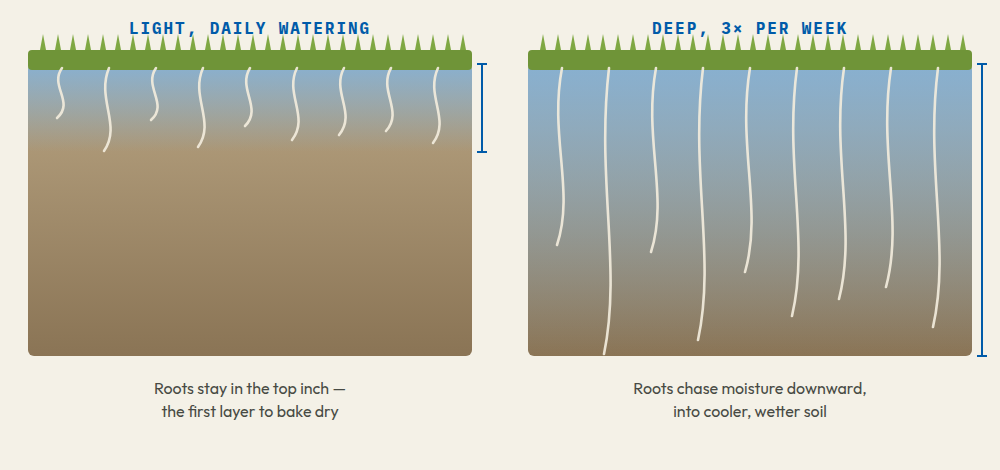
Aim to deliver enough water in each session that moisture reaches four to six inches deep. A cheap way to check: push a long screwdriver into the soil an hour after watering. It slides easily through moist soil and stops where the soil is dry.
Cycle and Soak: The Single Best Change You Can Make
Here's the problem with simply setting longer run times on Colorado Springs soils. Much of our region sits on heavy clay, which absorbs water slowly. Run a zone for 20 minutes straight and the last several minutes are often running off across the surface — down the driveway, into the gutter, and against the rules.
The fix is called cycle and soak. Instead of one long run, split each zone into two or three shorter cycles with a rest in between. Rather than 20 minutes at once, run roughly seven minutes, wait 30 to 60 minutes, then run seven minutes again, and repeat.
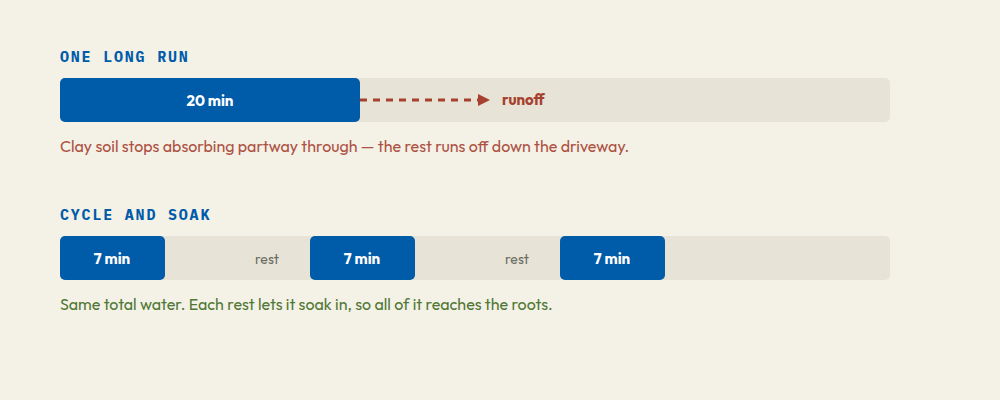
Same total water. Dramatically more of it actually in the root zone. Nearly every modern irrigation controller supports this, and on the ones that don't, you can achieve the same thing by programming two or three separate start times in the early morning.
If you make one change to your irrigation this summer, make it this one.
Mow High — Three Inches or Taller
Mowing height is the most underrated drought tool available to a homeowner, and it costs nothing.
Taller grass blades shade the soil surface. Shaded soil stays cooler and loses far less moisture to evaporation. Taller grass also supports a deeper root system, and it shades out the weed seeds that are waiting for a bare, sunny patch of dirt to germinate in.
Set your deck to three inches or higher for the rest of the season, and never remove more than a third of the blade in a single mowing. Keep the blade sharp, too. A dull mower tears the grass rather than cutting it, and every torn blade tip is an open wound losing water.
If Your Lawn Browns Out, Don't Panic
Kentucky bluegrass — the dominant lawn grass across Colorado Springs — has a built-in drought survival mechanism. Under sustained heat and moisture stress, it goes semi-dormant: growth stops, the blades brown off, and the crown and roots stay alive underground waiting for conditions to improve.
A lawn that browns in August is usually not dying. It's protecting itself. When September brings cooler nights and you keep water going to it, dormant bluegrass typically greens back up.
What you want to avoid is the worst of both worlds: letting the lawn go fully dormant, then panic-watering it back to green, then letting it go dormant again. That cycling is genuinely hard on the plant. Pick a lane. Either water consistently within the rules to keep it green, or water at a reduced maintenance level to keep the crown alive and accept some browning until fall.
Drought Stress Invites Pests and Weeds
Here's what catches people off guard. A drought-stressed lawn isn't just a cosmetic problem — it's a vulnerable one.
Mites thrive in hot, dry conditions and go after weakened turf, particularly on south- and west-facing slopes and along hot pavement edges. Grubs do more visible damage to a lawn that's already struggling, because a stressed root system can't outgrow the feeding. And thin, weak turf is an open invitation to weeds, which are far better adapted to drought than bluegrass is and which will happily colonize every bare spot.
This is the moment when staying on your regular fertilization and weed control program pays for itself. A well-fed lawn with an intact weed barrier goes into a drought with real reserves. A neglected one goes in with nothing and comes out the other side needing renovation.
A Ten-Minute Sprinkler Audit Worth Doing
Before you adjust anything else, run each zone and actually watch it. You're looking for heads spraying the sidewalk, heads blocked by grown-in turf, misaligned nozzles hitting the fence, and any head that's misting rather than throwing droplets — misting means the pressure is too high and much of that water is blowing away.
Then run the tuna can test. Set several straight-sided cans around a zone, run it for 15 minutes, and measure what collected in each. You'll learn two things at once: your zone's actual output rate, and whether coverage is even. Uneven coverage is why so many lawns have one chronically crispy area no amount of extra runtime seems to fix — the answer there is a nozzle repair, not more water.
Questions About Your Lawn This Summer?
If a section of your lawn is struggling and you can't tell whether it's a watering issue, a sprinkler issue, or something feeding on it, we're glad to take a look. Often a photo is enough for us to point you in the right direction.
J. Rick Lawn & Tree serves Colorado Springs and the surrounding communities including Flying Horse, The Farm, North Gate, Monument, Falcon, and Peyton, with lawn fertilization, weed control, tree spraying, and plant health care programs.
Call (719) 445-9985 or get in touch at jricklawn.com.
Frequently Asked Questions
How many days a week can I water my lawn in Colorado Springs?
No more than three days per week. From May through October, watering is also restricted to before 10 a.m. or after 6 p.m.
What is the best time of day to water a lawn in Colorado?
Early morning, ideally starting a few hours before sunrise. The air is cool and still, evaporation losses are lowest, and the blades dry as the sun comes up, which limits disease risk. Evening watering is allowed and workable, but it leaves the grass wet longer overnight.
How long should I run my sprinklers?
It depends on your soil, nozzles, and pressure, which is why the tuna can test beats any generic number. As a starting point, most Colorado Springs lawns need somewhere around an inch to an inch and a half of water per week in peak summer, delivered across three sessions and split into cycle-and-soak intervals.
Is my brown lawn dead?
Usually not. Kentucky bluegrass goes semi-dormant under heat and drought stress and typically recovers when temperatures drop in the fall. If you tug on the brown grass and it stays anchored, the crown is likely still alive.
Should I fertilize during a drought?
Stay on a properly timed program rather than stopping. What you want to avoid is heavy nitrogen pushing lush top growth the roots can't support in the heat. A well-planned program accounts for exactly this and keeps the lawn resilient rather than forcing it to grow at the worst possible time.
Can I water new sod or new seed more often?
New plantings have different needs, and most utilities have provisions for establishment periods. Check with Colorado Springs Utilities before you install, so you know what's allowed.
J. Rick Lawn & Tree is a locally owned lawn and tree care company serving Colorado Springs and the surrounding Front Range communities since 2011. Programs include lawn fertilization, weed control, bed weed control, tree spraying, and deep root fertilization.