


Emerald Ash Borer Has Reached Colorado Springs. Here's What It Means for Your Trees.
On August 5, 2026, the City of Colorado Springs and the Colorado State Forest Service confirmed the first detection of emerald ash borer inside city limits. If you have an ash tree in your yard, this is the news that finally makes the decision urgent.
We've been watching this insect march down the Front Range for years. It was first found in Colorado in Boulder back in 2013, and it has since been detected in more than 20 Front Range communities. Its arrival here was a matter of when, not if. Now that it's confirmed, the question for every homeowner with an ash tree is simple: is this tree worth protecting, and are we still early enough to protect it?
This guide walks you through how to tell whether you actually have an ash tree, what emerald ash borer damage looks like, and what your realistic options are.
What Emerald Ash Borer Actually Does
Emerald ash borer, or EAB, is a small metallic-green beetle native to Asia. The adult beetle itself does very little harm — it nibbles on ash leaves and moves on. The damage comes from its larvae.
Adult beetles lay eggs in the crevices of ash bark. When the larvae hatch, they tunnel through the bark into the layer of living tissue just beneath it, and they feed there through the fall and winter. That layer is the tree's plumbing. It's how water and nutrients move from the roots to the canopy. As the larvae carve their winding tunnels, they sever those pathways one by one.
The tree effectively starves from the top down. It happens quietly, and by the time most homeowners notice something is wrong, the beetle has usually been present for two to four years.
The number that matters: roughly 95% of untreated ash trees will not survive an EAB infestation. The Colorado State Forest Service puts it even more plainly, noting that without ongoing treatment, infested ash trees will die — often within two years of showing symptoms.
Why This Is a Big Deal in Colorado Springs Specifically
Ash was planted heavily across the Front Range for decades, and for good reason. It grows fast, tolerates our alkaline soils and dry climate, and throws excellent shade. Drive through almost any established Colorado Springs neighborhood and you'll see mature ash lining the streets and shading the backyards.
That popularity is now the problem. City officials estimate that if emerald ash borer goes unchecked, it could eliminate roughly 20% of Colorado Springs' total tree canopy within 15 years. That's one in five trees.
For an individual homeowner, the stakes are more personal. A mature shade tree in Colorado is not easily replaced. It represents decades of growth, meaningful summer cooling for your home, and real property value. Removing a large dead ash typically costs well more than years of preventive treatment would have.
First Things First: Do You Even Have an Ash Tree?
A lot of homeowners aren't sure. Ash gets confused with elm, walnut, and boxelder all the time. Here's how to check, and you can do all of it standing in your own yard.
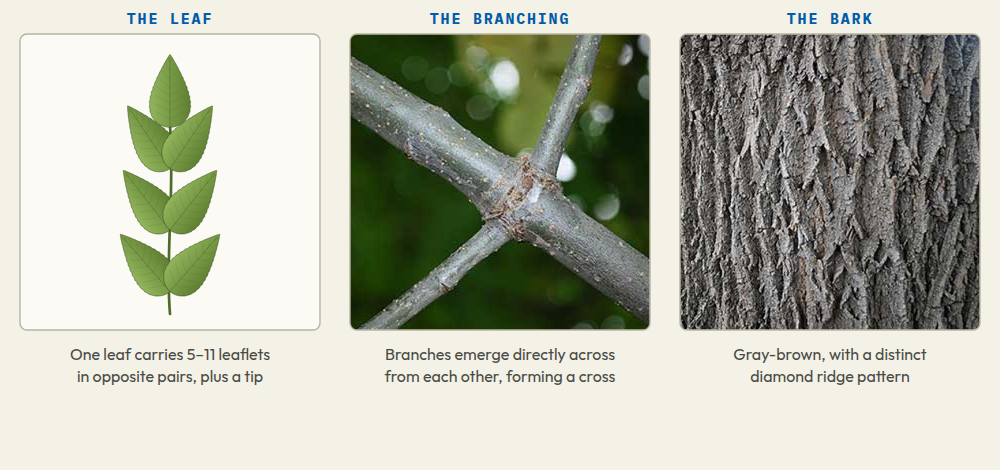
Look at how the branches attach. Ash trees have opposite branching, meaning branches emerge from the trunk directly across from one another, forming a cross. Most trees have alternate branching, where limbs stagger up the trunk. Very few common Colorado trees have true opposite branching, so this one feature narrows the field fast.
Look at the leaves. An ash leaf is compound. What looks like a single leaf is actually one stem carrying 5 to 11 smaller leaflets, arranged in pairs opposite each other with one leaflet at the tip.
Look at the bark. Mature ash bark is gray-brown with a distinctive diamond or interlacing ridge pattern. Once you've seen it, it's hard to unsee.
If your tree has opposite branching, compound leaves with 5 to 11 leaflets, and diamond-patterned bark, you almost certainly have an ash — and you should keep reading.
Signs Your Ash Tree May Already Be Infested
EAB hides its early work well. Damage starts in the upper canopy, out of easy view, which is why infestations routinely go unnoticed for years. Watch for these:
- Thinning or dieback at the top of the canopy. This is usually the first visible symptom. The tree looks sparse up high while the lower branches still leaf out normally.
- D-shaped exit holes. When adult beetles emerge, they leave a distinctive hole roughly 1/8 inch across, flat on one side. The shape matters — round holes usually mean a different, less serious insect.
- S-shaped tunnels under the bark. If a piece of bark falls away, look for winding, serpentine galleries packed with sawdust-like frass.
- Sprouts growing from the trunk or base. Known as epicormic shoots, these are a stress response — the tree trying to push out new growth below the damage.
- Heavy woodpecker activity. Woodpeckers hunt EAB larvae. Sudden, concentrated pecking on an ash trunk, sometimes leaving light patches where bark has been stripped, is a well-known early warning sign.
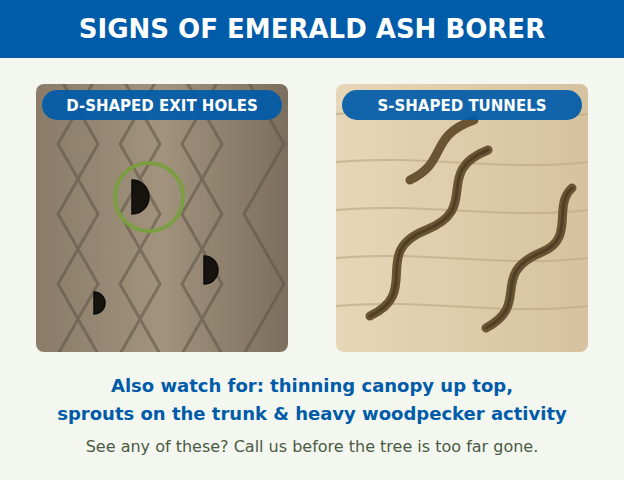
Seeing one of these doesn't confirm EAB on its own. Seeing several together on an ash tree is worth a professional look right away.
The Good News: Healthy Ash Trees Can Be Saved
This is the part that gets lost in the alarming headlines. Emerald ash borer is treatable, and treatment works well when it's done in time.
Preventive trunk treatments protect healthy ash trees by putting the insecticide into the tree's own vascular system, where feeding larvae encounter it. Applied on a proper schedule, these treatments are highly effective at keeping a healthy ash healthy.
The catch is timing. Treatment is a protection strategy, not a rescue strategy. Once a tree has lost a significant share of its canopy, too much of its plumbing is already destroyed for treatment to reliably turn things around. Industry guidance generally holds that a tree with more than about 30% canopy loss is a poor candidate.
That's why the confirmation in Colorado Springs matters so much right now. Trees that look perfectly healthy today are exactly the trees that can be protected. Waiting until a tree looks sick usually means waiting too long.
Should You Treat It or Remove It?
Not every ash tree is worth treating, and we'd rather tell you that honestly than sell you a treatment that won't pay off. A few things we weigh:
How healthy is the tree right now? A vigorous ash with a full canopy is a strong candidate. One already in decline from drought stress, poor siting, or old damage may not be.
How big and how well-placed is it? A large ash shading your house or your patio delivers real value every summer. A smaller ash tucked in a back corner may be easier to replace with a species that has no EAB risk at all.
What's the long game? Treatment isn't one-and-done. Protecting an ash means committing to a repeating schedule for as long as you want the tree. For a valuable shade tree, that math usually works out strongly in favor of treating. For a marginal tree, planned removal and replacement can be the smarter call.
What We Recommend Doing This Month
If you have an ash tree in Colorado Springs, Monument, Falcon, or Peyton, take three steps.
First, confirm it's an ash using the branching, leaf, and bark checks above. Second, look up into the canopy and note whether the top looks as full as the rest of the tree. Third, get an assessment before the season closes out — the treatment window is tied to the tree's growth cycle, and every year of delay is a year the beetle gets a head start.
J. Rick Lawn & Tree offers free ash tree assessments across Colorado Springs and the surrounding communities, including Flying Horse, The Farm, North Gate, Monument, Falcon, and Peyton. We'll evaluate the tree's health, tell you plainly whether it's a good candidate for protection, and lay out what treatment would involve. If we don't think the tree is worth treating, we'll tell you that too.
Call (719) 445-9985 or request an assessment at jricklawn.com.
Frequently Asked Questions
Is emerald ash borer dangerous to people or pets?
No. EAB poses no risk to humans or animals. It feeds only on ash trees. The danger is entirely to the tree.
How fast does emerald ash borer kill a tree?
Once symptoms are clearly visible, an untreated ash typically declines rapidly and often dies within about two years. The beetle is usually present for several years before symptoms appear.
Can I treat my ash tree myself?
Homeowner soil-drench products exist, but they're generally less effective than professional trunk applications, particularly on larger trees. For a mature shade tree you actually care about, professional treatment is the reliable option.
When is the best time to treat for emerald ash borer?
Treatment timing is tied to the tree's active growth, so spring through early summer is typical for most applications. If you're outside that window, the right move is to get on the schedule for the next one rather than skip a year.
What if my ash tree is already infested?
It depends on how far along it is. If canopy loss is limited, treatment may still succeed. If the tree has lost much of its canopy, planning a safe removal is usually the responsible choice — dead ash becomes brittle quickly and gets more dangerous and more expensive to take down the longer it stands.
Does my neighbor's infested ash put my tree at risk?
Yes. Adult beetles fly, and infestations spread through neighborhoods. If EAB has been confirmed nearby, protecting a healthy ash becomes more urgent, not less.
J. Rick Lawn & Tree is a locally owned lawn and tree care company serving Colorado Springs and the surrounding Front Range communities since 2011. We provide tree spraying, plant health care, deep root fertilization, lawn fertilization, and weed control.